Hi everyone,
One more month of project and one less to finish the PhD. What a stress!
Currently finishing the final piece of research work to start the worst nightmare of every PhD, writing :) Well, I already started ...let's be honest...otherwise I would be in trouble (and maybe I 'm already in trouble)...
This must be a thing of age, but 3 years sure go fast.
Well, I am still preparing to go to one of my last conferences (yes, crazy to still consider conferences, but these are progressively more important) and a couple of "extra things".
Today I'll spend some time to talk about one of the lessons I learned during all this time working with statistics and probabilistic models (or maybe this comment extends to research in general) .
This week I was thinking... this thing of the "getting up the chair and screaming YES!!!" moment must be a myth... Why?
Mainly because a real contribution comes from many almost YES moments :) its just that these years made me learn that it is not recommended to "celebrate" too soon heheh
You see the most brilliant minds in history saying that hard-work is almost everything and for sure they know it.
People are amazing identifying patterns, and that's what you spend most of your time doing in research (theoretical or experimental, even though that theoretical is a bit different).
Particularly in statistics, where there is this randomness associated, one can never celebrate too soon if something you're working on effectively "works".
Statistics is a bit tricky in this, because you can never be too confident that you have some pattern or "working" thing to in the end realize that you were just super"lucky". Having then to deal with the after-unhappiness and -disappointment ...
This is why I have the feeling that people from statistics can never get up the chair in the middle of the office and scream "YESSS!" in this moment of "heat" (at least not because of work).
You really need to be extra careful before doing any celebration... test all the things ...many times... and many times again.... and many times again... confirm the statistics... etc etc
This of course applies to all the research, whether you're in the lab, or trying to represent some physical phenomena with maths.
Nevertheless, with this feeling of "never-eureka" coming, comes preserverance and "earth-footing" which is of major importance to at least complete a PhD.
Well, not that was expecting to have it in first place... But it is funny. Movies are always better. Even more, progressively I feel that I understand less of what I am working. People say it is normal....
See you (this time don't know when I will have the strength to come here write)
Rui
Saturday, 14 April 2018

Sunday, 11 February 2018
Trainning Week Trinity and University College Dublin
Hi everyone,
Quite the cold out there, no?! And what do we do? Write a blog post!
Naan that's not true, otherwise, with such a weather here I would post almost every day :)
So, we had recently the trainning week here. Very focused on business and more soft skills, such as project management or even how to manage an interview.
I am not a capitalist by nature but I have to say that business can be quite interesting and challenging.
When you're used to numbers and to analyse very difficult things as most of the things you deal with when doing a PhD in engineering you may tend to depreciate how hard it is to succeed at business. Truth is that it is really hard.
You need to have an additional set of skills (for good and bad). Lot's of people only use the good ones, lots both and lots only the bad ones. Even if you do not have any interest in business itself, the activity remains quite interesting from the psychlogical point of view.
The thing is that this is a field that I do not know yet well. I read a lot about people ( all these major nd minor new entrepeneurs), and see many things but I didn't gather enough independent tought to be able to conjecture about it.
The training week was interesting because of that. Basically, I am still chewing my opinion on business and how to deal with it. Will I keep chewing my whole life? Thats the question.
Regarding work, same as always. Finishing a PhD in 3 years is quite demanding. You can see that by the lack of activity here. I feel that I cannot wrap my mind over anything else than the PhD for now. Still 6~7 months to go. I can see the light at the end of the tunnel :) lets see if it is a good light or a train to run over me hahah
Well, working on finishing research now...to start writing (or compiling) ASAP. Stressfull.
And the random ending notice of this blog is, please travel as much as you can. This is something that is coming a lot now in new generations. And why? Go out there find it ;) Ill talk about it in my next post.
See you soon,
Rui
Friday, 1 December 2017
Reliability in the engineering world and visiting Phimeca
Hi everyone!
Here we are again.
I told you that I was going to depart in a new experience very soon, and that was no lie.
Today I am finishing a visit I did to Phimeca, in France. Phimeca is an engineering company that is committed to bring the statistical know-how to the engineering world.
Well, and that is no easy task. Imagine that you ar a more classic structure stakeholder, and someone tells your... look lets use some of our mathematical knowldege to improve this structure operation and make it more safe. You would be like , okay...hum...interesting. Where do we start?
And then: Why don't we use some polynomial chaos expansion to replicate etc etc You are like: wwooow , halt! Polynomial chaos.... that doesn't sound very safe!!! (not the right name to captivate users out of research)
Or, well, lets evaluate the probability of failure. And you as structure stakeholder are like... whatt !?! This is going to fail?! Whats this!?!
Or, this is very conservative... and you as stakeholder are like: Great!! Will never fail! Go away.. no need...
You can see more or less how challenging this can be to implement in the real world in terms of awareness.
Nevertheless, introducing statistical know-how is much more powerfull than one can imagine and is really growing.
Easy, just you take a look at all the standards and see the progressive increase in the need to assess uncertainty. It is no joke. Characterization of uncertainty really makes you robust to what's to come. If we now have huge amounts of data we can acess, why not to use it?
I think I told you before, but I used to put statistics on a second row of importance when comparing to structural analysis or fluid mechanics... But that was so wrong. Now, I am not leaving it ever. Give it a try too! You wont regret.
Well, why I came in contact with Phimeca is simple. They are high profile experts in the field of reliability and all its complex techniques. In my particular case, Kriging models, their knowledge was of great help and I can tell that I learned a lot.
But soon back home, to continue work there!
I know I said that I was going to write about thinking globally, that I always emphasise in my posts. But no inspiration today. Being busy really cuts of you capability to think more generally.
Well, I can tell you that I have been quite busy. I had a paper accepted in a Journal, finally. (so hard to get it) And, I am working in some amazing stuff (I'm a pessimist by nature, so when I say its amazing, I think it really is... ).
2018 the final year of the PhD. Things are getting busy, so that I do not have time to divagate about the world problems....which is good and bad ! They say ignorance is bliss and that's no lie :)
But let's stay brainless-less, all of us. As soon as inspiration comes I'll come with the thinking global post (more criticism on top of cynism ...basically).
Nooo, it really is important to think globally. The lost of this sight is what brought us here today (in my opinion).
See you soon,
Rui
Here we are again.
I told you that I was going to depart in a new experience very soon, and that was no lie.
Today I am finishing a visit I did to Phimeca, in France. Phimeca is an engineering company that is committed to bring the statistical know-how to the engineering world.
Well, and that is no easy task. Imagine that you ar a more classic structure stakeholder, and someone tells your... look lets use some of our mathematical knowldege to improve this structure operation and make it more safe. You would be like , okay...hum...interesting. Where do we start?
And then: Why don't we use some polynomial chaos expansion to replicate etc etc You are like: wwooow , halt! Polynomial chaos.... that doesn't sound very safe!!! (not the right name to captivate users out of research)
Or, well, lets evaluate the probability of failure. And you as structure stakeholder are like... whatt !?! This is going to fail?! Whats this!?!
Or, this is very conservative... and you as stakeholder are like: Great!! Will never fail! Go away.. no need...
You can see more or less how challenging this can be to implement in the real world in terms of awareness.
Nevertheless, introducing statistical know-how is much more powerfull than one can imagine and is really growing.
Easy, just you take a look at all the standards and see the progressive increase in the need to assess uncertainty. It is no joke. Characterization of uncertainty really makes you robust to what's to come. If we now have huge amounts of data we can acess, why not to use it?
I think I told you before, but I used to put statistics on a second row of importance when comparing to structural analysis or fluid mechanics... But that was so wrong. Now, I am not leaving it ever. Give it a try too! You wont regret.
Well, why I came in contact with Phimeca is simple. They are high profile experts in the field of reliability and all its complex techniques. In my particular case, Kriging models, their knowledge was of great help and I can tell that I learned a lot.
But soon back home, to continue work there!
I know I said that I was going to write about thinking globally, that I always emphasise in my posts. But no inspiration today. Being busy really cuts of you capability to think more generally.
Well, I can tell you that I have been quite busy. I had a paper accepted in a Journal, finally. (so hard to get it) And, I am working in some amazing stuff (I'm a pessimist by nature, so when I say its amazing, I think it really is... ).
2018 the final year of the PhD. Things are getting busy, so that I do not have time to divagate about the world problems....which is good and bad ! They say ignorance is bliss and that's no lie :)
But let's stay brainless-less, all of us. As soon as inspiration comes I'll come with the thinking global post (more criticism on top of cynism ...basically).
Nooo, it really is important to think globally. The lost of this sight is what brought us here today (in my opinion).
See you soon,
Rui
Sunday, 15 October 2017
ICSI 2017 Conference and small update
Hi all,
Here we are again ! After some time as always...
I have been crazy busy lately...I didn't even have much time to breath!
A new post. Just a small update. Last week we were threatened that the person(s) with less posts in TRUSS blogs will need to perform some irish dancing here in Dublin...so here I am posting. Not that I wouldn'te dance...but I want to save the world that terrible image...
Last month of September I was in a conference in Madeira, Funchal (by the way, very beautiful island...heheh) about structural fatigue and its analysis. For me, that I am working mainly in the way probabilistic problems are applied to physical problems but with a strong focus on the statistical part, this was very interesting. It helped me to improve my perception on how the other researchers look at the physical problem of fatigue. And more important is that I could talk with some of the big experts on fatigue and understand a bit more the topic, that is not an easy one...
Conference on your specific topic are the best but from my experience you should consider sometimes a conference on different topics in order to make your knowledge more robust.
I had the opportunity to do a presentation of a paper with a pre-assessment of the design of experiments of a OWT tower. As I don't know much about fatigue (well... not much about statistics too hahah) I felt a bit lost sometimes. But in the middle of the difficulty you can always extract positive points. And the funny part is that, this was probably the conference where I got more interest in my work. It is a bit funny... as I am strongly focused on the statistical analysis and the conference was not really directed at it (despite having lots of people working on the probabilistic part of the fatigue).

It is in fact a bit surprising that in a non-specific conference people show the most interest. I will assume that it is because I have more mature ideas now. But in some way it is an indicator of how, in research, everyone is so "interiorized" in their own topics that some interaction is lost... you know what I mean...
In work, I will be moving very soon to work on new stuff and new experiences ...but I'll come back soon with this and I'll talk a bit about thinking globally, which I believe I talked about before. But it is never to much.
See you soon,
Rui
Here we are again ! After some time as always...
I have been crazy busy lately...I didn't even have much time to breath!
A new post. Just a small update. Last week we were threatened that the person(s) with less posts in TRUSS blogs will need to perform some irish dancing here in Dublin...so here I am posting. Not that I wouldn'te dance...but I want to save the world that terrible image...
Last month of September I was in a conference in Madeira, Funchal (by the way, very beautiful island...heheh) about structural fatigue and its analysis. For me, that I am working mainly in the way probabilistic problems are applied to physical problems but with a strong focus on the statistical part, this was very interesting. It helped me to improve my perception on how the other researchers look at the physical problem of fatigue. And more important is that I could talk with some of the big experts on fatigue and understand a bit more the topic, that is not an easy one...
Conference on your specific topic are the best but from my experience you should consider sometimes a conference on different topics in order to make your knowledge more robust.
I had the opportunity to do a presentation of a paper with a pre-assessment of the design of experiments of a OWT tower. As I don't know much about fatigue (well... not much about statistics too hahah) I felt a bit lost sometimes. But in the middle of the difficulty you can always extract positive points. And the funny part is that, this was probably the conference where I got more interest in my work. It is a bit funny... as I am strongly focused on the statistical analysis and the conference was not really directed at it (despite having lots of people working on the probabilistic part of the fatigue).

It is in fact a bit surprising that in a non-specific conference people show the most interest. I will assume that it is because I have more mature ideas now. But in some way it is an indicator of how, in research, everyone is so "interiorized" in their own topics that some interaction is lost... you know what I mean...
In work, I will be moving very soon to work on new stuff and new experiences ...but I'll come back soon with this and I'll talk a bit about thinking globally, which I believe I talked about before. But it is never to much.
See you soon,
Rui
Monday, 31 July 2017
The importance of characterizing your random inputs and their influence in your probabilistic process.
Hi everyone,
So its time for a new message in the blog about work.
I told you before that I was looking at these very cool models called Kriging models. Well, I m still looking at them, but now I have been inveting some time on the analysis if their design of experiments, or, the variables that are used to create the model that, lets say, stay on our x axis (y axis will give the output, just imagine a 2D curve).
Why is it important to look at these variables before any further progress? I have the surrogate model, I have the means to compute the results, why spend some time doing tests with these variables?
Well, maybe you don't need, but lets see why it is important.
When you run an experiment some variables affect much more the output of your experiment than the other. So, if a variable is 98% responsible for the variations in your output why should you consume your time looking at the other variables. You just do it once, you quantify these relations between variables and then in future experiments you now "whats happening". This is of particular interest in the case where you're going to repeat your experiments a lot!
But do not forget, this preliminary analysis, usually called, sensitivity analysis, needs to be very well done. Otherwise you may neglect important effects. Like coupled effects or similar.
So, you spend some more time in this and in the future you just save some time. We just need to believe that the balance will be positive. And it is very likely to be.
In cases where budget and time is a limited resource (in other words, always), this can be very interesting.
I believe and I heard it many times before from big scientists that, no additional complexity should be added to the analysis if it is not needed. Or, that "simple is beautiful".
In the case of Offshore Wind Turbine Towers there are many many variables that affect the behaviour of the turbine. As a very complex technology, its analysis is time consuming, so, characterizing well the different variables that affect the turbine is important before going on loops trying to do new things. Basically, before trying intensive research !
Even more when you work on probailistic research, quantifiying uncertainty adds a new layer of complexity and effort, so this is even more important.
To analyse the influence of the different variables there are many different techniques, Screening, Sobol, Anova, KL divergence, you can find many in the literature. Also, different techniques exist to simulate experiments, as the simple Monte Carlo or the Latin Hypercube Sampling. If variables ar correlated it gets a bit more complex, but still feasible. You can find many of them in literature.
Well, all this just to tell you that despite looking a secndary task from your main topic, or boring in some way, sensitivity analysis are very relevant and they can be a milestone when you're doing research in terms of saving time and resource and in the end your skin. Its like that subject that you're never into during the university but suddendly when you start working you realise it is much harder than it looks and much more important.
I know I know, some of you will now say....I didn't need 95% of the university courses.... bu this one for sure you needed and for sure it was diluted in the many different courses and you probably never had it to its full extent.
I recomend some reaidng on the topic. Very interesting indeed!
See you soon!
So its time for a new message in the blog about work.
I told you before that I was looking at these very cool models called Kriging models. Well, I m still looking at them, but now I have been inveting some time on the analysis if their design of experiments, or, the variables that are used to create the model that, lets say, stay on our x axis (y axis will give the output, just imagine a 2D curve).
Why is it important to look at these variables before any further progress? I have the surrogate model, I have the means to compute the results, why spend some time doing tests with these variables?
Well, maybe you don't need, but lets see why it is important.
When you run an experiment some variables affect much more the output of your experiment than the other. So, if a variable is 98% responsible for the variations in your output why should you consume your time looking at the other variables. You just do it once, you quantify these relations between variables and then in future experiments you now "whats happening". This is of particular interest in the case where you're going to repeat your experiments a lot!
But do not forget, this preliminary analysis, usually called, sensitivity analysis, needs to be very well done. Otherwise you may neglect important effects. Like coupled effects or similar.
So, you spend some more time in this and in the future you just save some time. We just need to believe that the balance will be positive. And it is very likely to be.
In cases where budget and time is a limited resource (in other words, always), this can be very interesting.
I believe and I heard it many times before from big scientists that, no additional complexity should be added to the analysis if it is not needed. Or, that "simple is beautiful".
In the case of Offshore Wind Turbine Towers there are many many variables that affect the behaviour of the turbine. As a very complex technology, its analysis is time consuming, so, characterizing well the different variables that affect the turbine is important before going on loops trying to do new things. Basically, before trying intensive research !
Even more when you work on probailistic research, quantifiying uncertainty adds a new layer of complexity and effort, so this is even more important.
To analyse the influence of the different variables there are many different techniques, Screening, Sobol, Anova, KL divergence, you can find many in the literature. Also, different techniques exist to simulate experiments, as the simple Monte Carlo or the Latin Hypercube Sampling. If variables ar correlated it gets a bit more complex, but still feasible. You can find many of them in literature.
Well, all this just to tell you that despite looking a secndary task from your main topic, or boring in some way, sensitivity analysis are very relevant and they can be a milestone when you're doing research in terms of saving time and resource and in the end your skin. Its like that subject that you're never into during the university but suddendly when you start working you realise it is much harder than it looks and much more important.
I know I know, some of you will now say....I didn't need 95% of the university courses.... bu this one for sure you needed and for sure it was diluted in the many different courses and you probably never had it to its full extent.
I recomend some reaidng on the topic. Very interesting indeed!
See you soon!
Monday, 10 July 2017
ESREL2017 Conference and Renewable Energy
Hi everyone!
Just last month was the ESREL conference and I had the opportunity to participate and present some of the work that I have been developing on OWT reliability.
ESREL its quite a big conference, probably the biggest or one of the biggest in Europe about reliability.
I have to say that it was an interesting experience, met lots of interesting people. Other ITN students (working on wind turbines...wow), which makes me happy to see such an interest in reliability and addressing uncertainty for OWT. But mostly, the opportunity to interact in an international conference and present some work, reuniting some good comments, good contacts, that was great.
Here I am doing the presentation, still need to train a bit more to lose some stiffness in the stage :)

Next I will be at home, Madeira, for a Conference in September called ICSI2017. I hope at least so interesting as this one.
Okay okay, these things of conference and all is interesting, but... More than important to get yourself and your "brand" known...
It looks like in renewable energy we are going back in time (in fact in everything not only renewable energy) and we need to work together to fight some of these ideas/seeds that are being implemented slowly on people heads.
It looks like in renewable energy we are going back in time (in fact in everything not only renewable energy) and we need to work together to fight some of these ideas/seeds that are being implemented slowly on people heads.
Some time ago I saw this amazing video by Neil deGrasse Tyson (below), one of the most outreaching persons in science that always has one of those arguments in the sleeve. I think it mirrors how surprising in a negative sense is this discussion over science, global warming and everything.
I believe, and believe well applied here, that it really looks silly when you hear all these arguments that contradict some scientific facts.
It is true that science can be wrong, and it happens, but just the fact that people identify patterns in their studies, that means that something is happening there and it does not matter if it is important or not on a first phase.
Some people criticize how science is made, and on how some studies are accepted with low confidence and all that but in fact that is not true.
But be aware, things are published when patterns and occurrences show that something that is widely correlated is happening. The results show it. You, that have access the data, may be interpreting the results on your own way, maybe wrong, but the truth is that something that is widely correlated is happening. It is not just something that happened by luck in one experiment. It can start like that, but then you repeat and repeat ... and if the pattern is there...its just not a matter of luck...
Then, your results go to be reviewed by other scientits...and believe me...it is a competitive world...
It is like you work for a company, lets say for example McRui, and someones presents you a burger from Burger Rui that is undoubtedly good. Well, you will try to say that it is no good because its painful to believe that burgers better than yours may exist. But if it really is, you don't have other choice than accept it and try to improve your own burgers. Remember, science is supported on quality, not on anything else...
And that thing of fake results does not exist. See the example, one of the most prominent guys of anti-vaccination was caught in the past because of its biased results...and lost his degree. So that myth does not exist. Lie has short legs. And shorter than usual in science.
Well, there is lot to be said, but remember :
You cannot say that you do not believe on a scientific fact. That just does not make sense. You can choose to believe or not in many thing, just not on science. Its not a matter of whether you believe or not. Please stop that.
If you really don't "believe" in the global warming by human hands (apart from other effects we are indeed accelerating it) or vaccines or whatever and on the importance of the renewable energy, please go read a bit about it.
I challenge you to do some science to prove the contrary. And make it accepted by a renowned entity !
See you soon,
Rui
Monday, 29 May 2017
Applying the Kriging Models in Structural Reliability
Hi all,
I will then, as promised, talk a bit today about the Kriging surface models.
These models are nothing more than surrogate models that account for a certain level of uncertainty. They are widely used for many fields, but their initial application goes back to geostatistics.
They are an interesting tool that we don't hear much about when learning Engineering. On the other hand, if you talk with a Geologist they will know for sure about what you're talking. I share my office with some people from Geology, and they do. They are all happy when they see me working with it... it's like... "look at this Engineer in trouble with these simple Kriging" haha
Well, as I told before these are nothing more than interpolators. The image below will help you understand (courtesy of Wikipedia):

The idea of the Kriging surrogate model is to approximate a group of points in a N-dimensional space with a curve. Like you would do with a 2nd, 3nd or n degree polynomial. But in this case, we assume that the space between the points we do not know as an error which is Gaussian distributed.
Let's see, you see the red dots, these are the points that we know. If we assume a deterministic interpolation scheme we will have the red line or another line (depending on the order of the approximation) that will in the limit be the same as the trimmed blue line. For such a complex model it's hard to have exactly the blue trimmed line if we use a reasonable amount of points, so we are very likely to be induce in some kind of error in our prediction of the variation of z with x.
Where does the Kriging surface comes into play then? Well, if you assume the Kriging surface for the same set of points you will have the gray area, mixed with the red line. This means that you know that your blue trimmed lined will be, with 95% confidence, inside that area. (!! but it can be out! The Gaussian distribution tails are not bounded). So, let's say it is like a model, that fits infinite curves to a certain group of points.
With one single sample of points for all the domain of x from the Kriging:
If you're lucky you will have the exact same blue curve...well....very very lucky....
If you're not, you will end up with an approximation that is worst than the red line (which is the expected curve). If you take many many "samples of this curve" you will end with the red line, the expected curve.
Can you see the interest now? They are indeed an amazing piece of math. You can tell, well, whats the point? It's all left to the luck? Or, I'll end up with a red curve anyway?
Well, do not forget that so many things in this world follow a Gaussian distribution... and a tool like this one, which is simple and beautiful, can be widely implemented in this world for much more than just approximating curves or a couple of points.
If you have a system's output that is Gaussian distributed and depends on many variables you can use this, like I am doing. If you're not sure about your curve and you want some degrees of uncertainty, here we are :) etc etc...
I am pretty sure that you're amazed, because the first time I saw this I was like: "This is way I am not going anywhere, such a simple and beautiful tool and I couldn't even think remotely on this existing inside my ignorance" :)
It was nice to write to you all.
For those who know me... I know I know...lately it's Kriging for this, Kriging for that... Kriging for beers... Kriging tatoo...I can't avoid it. I love the concept hehe
But I know I know, extra care in the application of them, as good-sense is needed.
See you soon and I hope you find the post interesting,
Rui
I will then, as promised, talk a bit today about the Kriging surface models.
These models are nothing more than surrogate models that account for a certain level of uncertainty. They are widely used for many fields, but their initial application goes back to geostatistics.
They are an interesting tool that we don't hear much about when learning Engineering. On the other hand, if you talk with a Geologist they will know for sure about what you're talking. I share my office with some people from Geology, and they do. They are all happy when they see me working with it... it's like... "look at this Engineer in trouble with these simple Kriging" haha
Well, as I told before these are nothing more than interpolators. The image below will help you understand (courtesy of Wikipedia):
The idea of the Kriging surrogate model is to approximate a group of points in a N-dimensional space with a curve. Like you would do with a 2nd, 3nd or n degree polynomial. But in this case, we assume that the space between the points we do not know as an error which is Gaussian distributed.
Let's see, you see the red dots, these are the points that we know. If we assume a deterministic interpolation scheme we will have the red line or another line (depending on the order of the approximation) that will in the limit be the same as the trimmed blue line. For such a complex model it's hard to have exactly the blue trimmed line if we use a reasonable amount of points, so we are very likely to be induce in some kind of error in our prediction of the variation of z with x.
Where does the Kriging surface comes into play then? Well, if you assume the Kriging surface for the same set of points you will have the gray area, mixed with the red line. This means that you know that your blue trimmed lined will be, with 95% confidence, inside that area. (!! but it can be out! The Gaussian distribution tails are not bounded). So, let's say it is like a model, that fits infinite curves to a certain group of points.
With one single sample of points for all the domain of x from the Kriging:
If you're lucky you will have the exact same blue curve...well....very very lucky....
If you're not, you will end up with an approximation that is worst than the red line (which is the expected curve). If you take many many "samples of this curve" you will end with the red line, the expected curve.
Can you see the interest now? They are indeed an amazing piece of math. You can tell, well, whats the point? It's all left to the luck? Or, I'll end up with a red curve anyway?
Well, do not forget that so many things in this world follow a Gaussian distribution... and a tool like this one, which is simple and beautiful, can be widely implemented in this world for much more than just approximating curves or a couple of points.
If you have a system's output that is Gaussian distributed and depends on many variables you can use this, like I am doing. If you're not sure about your curve and you want some degrees of uncertainty, here we are :) etc etc...
I am pretty sure that you're amazed, because the first time I saw this I was like: "This is way I am not going anywhere, such a simple and beautiful tool and I couldn't even think remotely on this existing inside my ignorance" :)
It was nice to write to you all.
For those who know me... I know I know...lately it's Kriging for this, Kriging for that... Kriging for beers... Kriging tatoo...I can't avoid it. I love the concept hehe
But I know I know, extra care in the application of them, as good-sense is needed.
See you soon and I hope you find the post interesting,
Rui
Monday, 24 April 2017
Update on research - Prologue to the probabilistic analysis of Offshore Wind Turbines (OWT)
Hello !
Here we are again, this time to talk a bit about work.
As you may know from previous posts I have been working on characterizing probabilistically the OWT towers, specifically for the fatigue analysis.
The fatigue analysis recomended for the design of OWT towers usually involves a very high number of simulations and some statistical distributions.
What is done is to run multiple simulations that reproduce the loads on the OWT; apply a methodology to count the loads that happen in every simulation; use the well know fatigue curves and linear damage sumation and then work on reproducing the best the complete lifetime of the turbine.
Obviously, it is quite unfeasible to make simulations for the full 10, 20 or many L years of simulations. So, what is usually done is to, using all the loads the we can obtain, extrapolate the loads for the period of time we want to design. This is assuming that the high load ranges will have the most impact on the fatigue life.
It is easy to understand that ideally the L years of life should be assessed completely, but that is a hard task. Even not "running" all the L years of loads accomplishing the design to fatigue is a heavy task. Now imagine if you want to run it for a probabilistic approach? Not easy. That would mean, for instance, simulating multiple turbines and see the variations in the extrapolation if you want to focus only on the loads. Naturally, there are other uncertainties that have also some influence in the expected life.
I have been working to implement a new methodology to assess the fatigue of the OWT and that is specifically working with Kriging surrogate models. The Kriging surrogate models are an amazing tool originnally developed for geostatistics that interpolates function in a Gaussian process. Is true, I was amazed the first time I ran into them. Of course, their Gaussian characteristic which accounts for some uncertainty and the possibility to interpolate functions made them quite popular for reliability. Therefore, recently their usage spread into the reliability world quite significantly.
As I believe they are a very interesting tool, I will keep a full post for them, and that will be the next one. For now this was a small introduction to present them.
Regards and see you very soon. This time as the topic is already introduced I won't be able to escape ;)
Rui
Here we are again, this time to talk a bit about work.
As you may know from previous posts I have been working on characterizing probabilistically the OWT towers, specifically for the fatigue analysis.
The fatigue analysis recomended for the design of OWT towers usually involves a very high number of simulations and some statistical distributions.
What is done is to run multiple simulations that reproduce the loads on the OWT; apply a methodology to count the loads that happen in every simulation; use the well know fatigue curves and linear damage sumation and then work on reproducing the best the complete lifetime of the turbine.
Obviously, it is quite unfeasible to make simulations for the full 10, 20 or many L years of simulations. So, what is usually done is to, using all the loads the we can obtain, extrapolate the loads for the period of time we want to design. This is assuming that the high load ranges will have the most impact on the fatigue life.
It is easy to understand that ideally the L years of life should be assessed completely, but that is a hard task. Even not "running" all the L years of loads accomplishing the design to fatigue is a heavy task. Now imagine if you want to run it for a probabilistic approach? Not easy. That would mean, for instance, simulating multiple turbines and see the variations in the extrapolation if you want to focus only on the loads. Naturally, there are other uncertainties that have also some influence in the expected life.
I have been working to implement a new methodology to assess the fatigue of the OWT and that is specifically working with Kriging surrogate models. The Kriging surrogate models are an amazing tool originnally developed for geostatistics that interpolates function in a Gaussian process. Is true, I was amazed the first time I ran into them. Of course, their Gaussian characteristic which accounts for some uncertainty and the possibility to interpolate functions made them quite popular for reliability. Therefore, recently their usage spread into the reliability world quite significantly.
As I believe they are a very interesting tool, I will keep a full post for them, and that will be the next one. For now this was a small introduction to present them.
Regards and see you very soon. This time as the topic is already introduced I won't be able to escape ;)
Rui
Sunday, 19 March 2017
New working paradigm
So, two posts ago we started a brief discussion about how work is faced nowadays, introducing also, the fact that the working reality is (looking like) changing.
People have been spending lots of time thinking on what is happening and I am not different. So I also brainstorm a bit about what is really happening everywhere... With so much crazy stuff happening around the world lately.
So, the exercise is simple: Let's look around us and think on what are we seeing everywhere.
Unemployment is in fact a big problem today as the society and capitalism is quite built on work. With it comes big migrating movements, further social inequality, is deeply connected with criminality, and etc etc...
Lots of the recent world changes, and specially the growing trends of radicalism are also connected to it. People are not happy in general and blame what they shouldn't blame, they are longing for change. Opportunists appear, as in EUA or UK appear and tell people exactly what they want to hear. In the end, you can't blame people for, in desperation or unhappiness, voting for change.
I read recently about the election in the EUA and how the middle regions EUA contributed strongly for the election of the current president. It stated that in average a middle class worker in the primary sector in these regions earned today the same as 40 years ago. Being this fact a reality, it is normal that these people are moving for change instead of keeping the same system.
In the UK things present the same trend. The big argument behind the Brexit was deeply connected to protectionism and work issues.
Okay, it's happening and its here among us. Everyone is worried about work issues, the change in lifestyle and not being able to have a "home". Everyone is voting for a change, and waiting for the measures to come with people that bring new ideas, that are going to "protect" the countries and etc...
Well, in fact its not going to happen. Everyone is searching for the answers in the past, and they are not there. People still move around where the few working opportunities are but let's see:
I always find funny when now and then Portugal presents the unemployment statistics and they are always decreasing (lately). So, let's see, world population is steadily increasing, work are decreasing due to automated work, so how can the unemployment be decreasing? Well, maybe if the population decreases... because decrease of automated work is not happening for sure...
It is proved that a huge share of the current work can be replaced by automats. It is proved that even the highly "thinking" jobs will be replaced in the future by machines. So, how will we be able to keep everyone occupied and earning money in the future? It is much more interesting for a business to have a machine that almost needs no attention than a person that is very demanding...
Work is changing to the point that now, the problem is work itself. We are wasting the last moments debating redundant stuff by electing all these weirdos to conduct countries, but just to realize that they do not have the answer too....
I believe that the problem is much more on the society roots than everyone is realizing. We can be here worried and criticizing everyone and how the life turned so harsh...
In the past people lived to work, they still do. But now, we need to adapt the coming generations for the change in the work paradigm and teach these people to live in other ways. How should we do this, that is a big question.
But for now, I believe we need to face work as the new social problem not in the sense that we need to find new works but in that they won't come again. Its a message that needs to be spread I think!
A big text just to talk a bout a drop in the ocean of the problems we face today :)
Sorry this is not really connected to wind energy, but its a message that needs to be spread as i told. Next post, very soon, we will be talking about wind and one issue I have been working on.
Sorry this is not really connected to wind energy, but its a message that needs to be spread as i told. Next post, very soon, we will be talking about wind and one issue I have been working on.
Rui
Sunday, 5 February 2017
End of secondment in Aberdeen and Training week Barcelona
Hi all ,


Sorry for the disappointing update frequency of this blog, its really a hard task a "not pure breeded social guy". That is why we all want to follow these guys that live of youtube and blogs, but almost anyone can make it :)
Well, I will do a quick update of the things at work and talk about how was the second phase of my secondment.
As you know I am now in Aberdeen. A city that I have to tell you is not as bad as as I thought in first place. I was thinking earlier this week, and its true, expectation is the secret for a happy life. Everyone was before, you're going to Aberdeen in Winter? Good luck! Or... you'll go crazy...etc etc
In the end it wasn't that bad. Its a small city but very nice. Its grey, its true, but has its own spirit. The times were better before when oil was "pumping" people say, well... its the time for new clean energy...I say :) use that positive tension to foment it.
So, this is my last week here. Well, I enjoyed but its time to go back. It was a very enriching experience.
Talking a bit about my work, which I rarely do but I should.
These for months of secondment contributed for settling interesting knowledge in the analysis of offshore wind turbines, modelling them, analysing loads, getting the feeling of "something is wrong with these results" and more, much faster than I would do anyway on my own. This helped to boost my work a lot and I have to say, I even exceeded my expectation on how much I could get in this 4+a bit months. Again, low expectations are the secret ! Haha
It went great, now its time to go back, settle knowledge and return in the future.
I have been working in applying probabilistic methodologies to Offshore wind turbines in the specific case of the fatigue. Fatigue is a very challenging topic for offshore wind turbines, it can drive the failure of towers for example but also its quite resource consuming. Its good to melt your brain !
Lets see, now that things are more settled in the analysis and understanding of the dynamics of the turbine, what value can be added to its probabilistic analysis. I already have very nice ideas that were submitted to a conference, but the complexity is big and I hope to talk about them here very soon.
You know that we had a trainning week in January? Yes, I would like to leave here a special thanks to all the organisers from TRUSS and UPC.
It was great, again, Its crazy how much you can learn when the teaching process is carefully aimed. We should really think about this...
Anyway, here we are; all happy. This is us:

And this is us v them (some of them...):
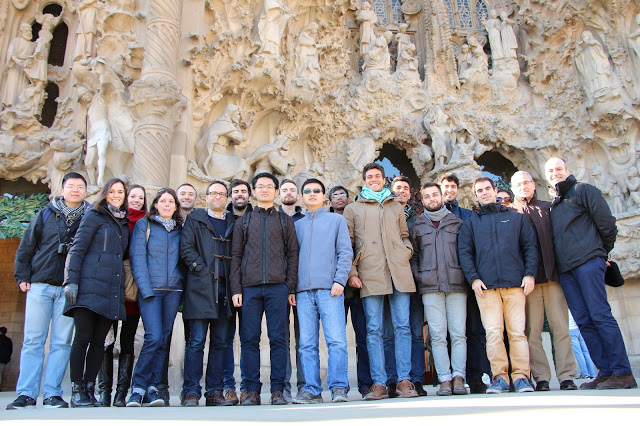
Well, I left a topic unfinished I hope to finish it next time. I'll also bring more news on work development too.
Tchin tchin ! New design too
Tchin tchin ! New design too
Rui
Sunday, 1 January 2017
End of first phase of secondment and 2017 greetings
Hello guys,
Here I am again to tell you a bit more about my recent adventures.
Last month I just finished the first phase of my secondment in London. What this means?! Yes, I left London...I'm now in Aberdeen, but midway I would like to share some of what I learn and how some things bother me...hmmm..
Overall the experience of the secondment in London was great! I won't say everything was a sea of flowers...no..it wasn't. The secondment experience can be quite disruptive. Among going to a big city, changes of house, one thousand travels, etc etc your energy gets "pulled" out of you quite fast and that can be really disruptive for your day to day work.
Fortunately, I experienced all of that, which is also an important part of the learning process, but from the work side I had a very productive learning experience that really minimised all the negative effects I mentioned.
I know I was lucky. When going on a secondment these conditions are unlikely to be found. That's why I would like to thank all the people that I worked with during these two months. (With a special thanks to my supervisor in Lloyd's from whom I learned crazy amount of stuff ).
I know I was lucky. When going on a secondment these conditions are unlikely to be found. That's why I would like to thank all the people that I worked with during these two months. (With a special thanks to my supervisor in Lloyd's from whom I learned crazy amount of stuff ).
They didn't save me from some little positive embarrassment in the goodbye with a speech (which is traditional from long term workers)... it was funny... So, here, thank you all!
Also, some days after leaving I won there (even not being there) a bottle of wine in a raffle...its funny...I never get one win in these things....and when I get....I'm not there hahaha
Also, some days after leaving I won there (even not being there) a bottle of wine in a raffle...its funny...I never get one win in these things....and when I get....I'm not there hahaha
Now, talking about other things...
One of the things that I enjoyed in Lloyd's was the working culture, and with that I learned a lot! I believe is something common in the places I got to know recently. There the culture is highly focused on the worker and it's life.
This is really great and positive and I am highlighting it here because it is something that always disturbed me as someone that sees the working culture decay everyday with the current mess we have in the world (Portugal is a very good "generalized" example for instance where the culture of work being already bad has also been decaying since the economical crisis).
This is really great and positive and I am highlighting it here because it is something that always disturbed me as someone that sees the working culture decay everyday with the current mess we have in the world (Portugal is a very good "generalized" example for instance where the culture of work being already bad has also been decaying since the economical crisis).
I always wondered how can lots of Portuguese companies sum so many hours of work and yet we are still quite a not very rich country comparing with the European average..(there are exceptions of course)? It took me ages to understand, and I didn't yet...
We know that there are numerous macroscopic "things" that explains this. Although, from the side of the work I believe we are doing it all wrong. During these 2 months I realised that having some positive "worker" working culture is really important.
We know that there are numerous macroscopic "things" that explains this. Although, from the side of the work I believe we are doing it all wrong. During these 2 months I realised that having some positive "worker" working culture is really important.
First point is, working too many hours is against your production as this usually means, for instance, having less time for yourself . And regardless of the job brainstorming or physical complexity, you need that time. I experienced both sides before, and this right balance much fomented by Lloyd's worked really well.
Second point, is imeasurable how much people can do when they are spiritually well. Okay, motivation is almos eveything but having a positive working culture really helps..its not just something adopted from the trendy IT companies out of nothing... it really works.
Second point, is imeasurable how much people can do when they are spiritually well. Okay, motivation is almos eveything but having a positive working culture really helps..its not just something adopted from the trendy IT companies out of nothing... it really works.
Well, the negative part is that currently there's no point in adressing deeply the talk about working culture.
There are companies that always worked bad (most of them), there are companies that always worked well. Maybe in the past the divergence and discomfort of the people working didn't show as much as now and that´s not because the new people are weak (as many people say) or are used to facilitism.
It is because in the past, there was plenty to everyone, so that any discomfort was covered by this plenty of advantages and economic resources given to the workers (e.g. extra-hours paid, crazy opportunities of progressing career, etc). Today, things are really different.
Anyway, its nice to defend and foment the working culture. We have seen lots of entities working hard on that but in reality the very short future tells us that the real challenge is what to do with people and their free time...
Starting 2017 in big style with a heavy message. Sorry! I had started this text in 2016 and in the first of the year I was lazy to start another text again...
Happy New Year !!! Enjoy 2017 and lets work together for the best success in this crazy changing world!
Ill be back soon with the continuation of my experience and reflection on working culture, or lets say, "non-working" culture !
There are companies that always worked bad (most of them), there are companies that always worked well. Maybe in the past the divergence and discomfort of the people working didn't show as much as now and that´s not because the new people are weak (as many people say) or are used to facilitism.
It is because in the past, there was plenty to everyone, so that any discomfort was covered by this plenty of advantages and economic resources given to the workers (e.g. extra-hours paid, crazy opportunities of progressing career, etc). Today, things are really different.
Anyway, its nice to defend and foment the working culture. We have seen lots of entities working hard on that but in reality the very short future tells us that the real challenge is what to do with people and their free time...
Starting 2017 in big style with a heavy message. Sorry! I had started this text in 2016 and in the first of the year I was lazy to start another text again...
Happy New Year !!! Enjoy 2017 and lets work together for the best success in this crazy changing world!
Ill be back soon with the continuation of my experience and reflection on working culture, or lets say, "non-working" culture !
Tuesday, 8 November 2016
Cmon, it's time to talk about work again...
Hi guys,
Yes..it's been a long time since I talked about work...so, no escaping today.
It's amazing, only one year has passed...fast like I don't know what..and I feel I have learned quite a lot. Well, but I'm still far from a relevant level...just 5 minutes of talking with any of my supervisors, at Trinity or Lloyd's to have my intelectual ego put at place again!
So, I started with a probabilistic assessment of the reliability methodologies used to analise offshore wind turbine towers and foundations, then I diverged to the analysis of external loads and how to extrapolate extreme events, with particular focus on significant wave heights. Currently I am again working on the turbine tower itself.
For that I have been learning and working with an amazing open source software that probably all of you are working with wind turbines know about; FAST developed by NREL from United States. For an open source software it's really capable. Basically, lets say its developers deserve a statue in the wind energy research world. Well, but not everything is a sea of flowers, it's learning curve can be quite harsh...
Lloyd's has been a great "support" so far. It's really good to have this close contact from a company with so much experience. Only "seeing" everything from the university can be quite hard to get the real awareness of how things are processed in the business world.
The analysis of turbine towers is straightforward but complex. They are calculated with the partial safety codes recommended in the standard and with support of several Design Load Cases (usually called DLC) to guide the designer. Of course these codes have a whole world of probabilistic assessment background.
No surprise that such a technological sector has such advanced techniques and a whole world of regulations behind. Well you know...its a big sector... usually, if "mountains" are not moved that means that there is not enough money at stake...
Anyway, dark things aside, like in almost every field (and one of the reasons why there is all this ruckus around the research world and its inadaptability to real applications) there are still some gaps between the industrial world and the research world.
I am now focusing on how to define the failure of the offshore wind turbines, and the first thing I have seen....there are lot's of really interesting methods, with really huge potential to be applied in the analysis of offshore wind turbines. We are talking of methods that probably are able to acess the reliability of a wind turbine for some of the more complicated DLC in less than one day.
Yet the industry still keeps analysing these same DLC in months or (more if multiple computers and processing methods are note use). What's wrong here?
I believe there is a big problem of perception...and I believe that almost everyone has this perception..so nothing new.
No surprise that such a technological sector has such advanced techniques and a whole world of regulations behind. Well you know...its a big sector... usually, if "mountains" are not moved that means that there is not enough money at stake...
Anyway, dark things aside, like in almost every field (and one of the reasons why there is all this ruckus around the research world and its inadaptability to real applications) there are still some gaps between the industrial world and the research world.
I am now focusing on how to define the failure of the offshore wind turbines, and the first thing I have seen....there are lot's of really interesting methods, with really huge potential to be applied in the analysis of offshore wind turbines. We are talking of methods that probably are able to acess the reliability of a wind turbine for some of the more complicated DLC in less than one day.
Yet the industry still keeps analysing these same DLC in months or (more if multiple computers and processing methods are note use). What's wrong here?
I believe there is a big problem of perception...and I believe that almost everyone has this perception..so nothing new.
These amazing methodologies, sometimes, are not that tangible. But tangible approaches in their way may not be that interesting from the point of view of research. For companies is hard to put so much at stake risking with something that they "cannot" touch to some extent. So, where do we stay here? Well, approaches like TRUSS are looking directly to fill this space full of new blood (don't look at it with all that inovative sense, this is the gap were more money is being invested lately). Maybe we won't turn 10000 time domain simulations in 70, but if we can make it 2000 Wooww!
In the end, apart from all the critics to the research world and industrial world we listen around magazines, news, etc, I really believe everyone is really bringing their best to achieve new improvements.
And this applies to everything, is really easy to sit and criticize so much stuff...and you don't need to be at home in the coach...or be the Portuguese called "bench coaches" (ones that criticize without any responsability or are deeply destructive in their approach) but also everyone in the profissional world, etc etc... So, be carefull with your approach if you in some sense feel that you don't know better, but deeply. And most of the times, if you really feel you know better, I would say you're wrong.
It gets always boring when the topic is work :) see you soon!
In the end, apart from all the critics to the research world and industrial world we listen around magazines, news, etc, I really believe everyone is really bringing their best to achieve new improvements.
And this applies to everything, is really easy to sit and criticize so much stuff...and you don't need to be at home in the coach...or be the Portuguese called "bench coaches" (ones that criticize without any responsability or are deeply destructive in their approach) but also everyone in the profissional world, etc etc... So, be carefull with your approach if you in some sense feel that you don't know better, but deeply. And most of the times, if you really feel you know better, I would say you're wrong.
It gets always boring when the topic is work :) see you soon!
Anyway,the real question that I have been wondering lately is, who programs the traffic lights in Dublin?... talk about real crazy and full of adrenaline experiences...
Saturday, 15 October 2016
New phase : Secondment
Hello guys!

Well, here I am to tell about the new phase I just got into.
In the beginning of October I just started my secondment at Lloyd's Register. Yes yes you all know it because I said in my previous post...but this time is for real, not just an especulation about what will happen.
So, this means 2 weeks in London working in a big company. For me, a completely different experience. I worked in a company before but this is big.
And big is really the word to qualify London.
First day of secondment and it was automatically beginner mistake. In London everyone dresses minimally formal, keep that in mind for future experiences. Well, it is not something that I am crazy about or support much but in this "old world" Is still a rule and it won't change in one day, takes time. Of course that with time I got my pace too.
People in my office are very nice too. Already made some good friends, friends of coffee, friends of the weekly day out to lunch, friends of works discussion and friends out of work...well...etc etc. The important part is that I have been around people that have lots of "kilometers" or better...miles in the offshore engineering field and that has been quite rewarding. Big learning process!
About London, is what you know, experienced or heard about. It's hugeeee! And crazy! I have been taking my time to walk around and know the city. For instance in Saturday I walked 27 km and Sunday I went to the Natural history museum and crashed in the middle of the visit (which took me 4h, you can tell how big) ...well, it was the weight of the age talking louder.
Some areas of London are lovely, really amazing. It's great for some time. Really great.
Already found, accidentally, a place to go chill out some time. A pleasant surprise. Definitely my favorite spot in London...but you need to go like 5 minutes before closing for 5 minutes of reflection. Or when it is raining like infinite, otherwise it will be packed.
It is just perfect to go out inside. Kyoto garden.
Well, that was all for now. I'll come back soon.
P.S. guys, no worries, I still prefer Dublin...I'll be back.
Monday, 12 September 2016
Quick Update and Start of New Season
Hello guys,
Here we are again after a long period out. My fault as always...
Today, I'll make a small update of the situation around here.
First, some new things!
Regarding work, things are progressing well. Just finishing a substantial part of the work now, one that I've been working the last months. And then embrace a new challenge.
Sooo, as part of the program I'll be moving to London and Aberdeen during 4 months starting very likely in the beginning of October. Going to work on a company called Lloyd's Register. Probably many of you heard about...
Well, Lloyd's Register it's a super company from the UK that has a cross sectorial approach with activity in many engineering fields. Offices all around UK, and that's what will make me go around a bit. Anyway, for sure a very enlightening experience.
Two weeks ago was in CERI2016 presenting a paper on the comparative assessment of methodologies to estimate the probability of failure of offshore wind turbine towers! Seeing some friends, doing new ones and discussing research in contemporary way. That was it!
Heavy TRUSS around there :)

To end, I'll leave you with the most recent creation by our "mastermind" behind the scenes... But let's leave that mastermind thing for when she receives her statue ...
I'll come back soon! Stay tuned!
Here we are again after a long period out. My fault as always...
Today, I'll make a small update of the situation around here.
First, some new things!
Regarding work, things are progressing well. Just finishing a substantial part of the work now, one that I've been working the last months. And then embrace a new challenge.
Sooo, as part of the program I'll be moving to London and Aberdeen during 4 months starting very likely in the beginning of October. Going to work on a company called Lloyd's Register. Probably many of you heard about...
Well, Lloyd's Register it's a super company from the UK that has a cross sectorial approach with activity in many engineering fields. Offices all around UK, and that's what will make me go around a bit. Anyway, for sure a very enlightening experience.
Two weeks ago was in CERI2016 presenting a paper on the comparative assessment of methodologies to estimate the probability of failure of offshore wind turbine towers! Seeing some friends, doing new ones and discussing research in contemporary way. That was it!
Heavy TRUSS around there :)

To end, I'll leave you with the most recent creation by our "mastermind" behind the scenes... But let's leave that mastermind thing for when she receives her statue ...
I'll come back soon! Stay tuned!
Tuesday, 14 June 2016
Landscape vs Wind Turbines
So, as promised, today I come with the topic: " Is the combination Wind Turbines-landscape good or not?".
Some of you may be thinking now: "Yes, sure they are!"; others, "Are you crazy? They're horrible!". The more "raw" people will be "This guy lost his mind, that's too relative and who cares...". And we continue further on...
That's it! This is how fundamental this question is. As an example I remember a story from one professor I had back when I was doing my degree.He called the "coffee machine story". (he was one of the "big-mans" behind the growth of wind energy in Portugal... country that, for the most distracted, just set last month the new record of time operating exclusively on renewable energy, 107 hours! Very proud! Good to break the ice and appear in the international news for good reasons!)
What's the story of the coffee machine? Back in the beginning of the Wind energy in Portugal he was getting a coffee in a conference and, at separated times, met two old colleagues from the time when he was studying.
So, he ran into the first, who immediately started to complain about a wind farm that was installed in the North:
- "What are you doing with those ugly machines? I cant even look now.. I'm almost covering my car's windows full of old landscapes photos to enjoy the way back! What will be the next step?!"
Of course, a big disappointment for someone that was putting so much heart into the wind turbines. 5 minutes after, comes the other old colleague:
-"How are you? It's amazing this new thing of wind turbines! Now every time I leave my home to work I go looking at them, such an excitement. Every morning I start wondering: Will they be rotating or not today?"
This shows the extent of the disparity between comments regarding the wind turbines vs the landscape. It happened in seconds!
Personally, I like them. When it come to the offshore ones, I even like to go the coast and see them. But I understand those who don't. Maybe seeing it everyday is not the same and well, this is it, everyone has different connections with the landscape.
Apart from the "small talk", there's one fundamental thing above all the criticism, the aesthetics and the "beautiness", to me these equipment are still one of the best shots that we have for "clean energy". They are big in power, have quite an acceptable life-cycle footprint and the environmental impacts are still among the less worst ones. Inside our system they are everyday more economically competitive and yes, they kill birds...but not all these people say...
Yes, I know...I know...There are other alternatives, and renewable energy is not everything when it comes to saving the world.
I agree, maybe the timing of renewable energy is not yet there. I know that we should focus on what we have first and make things more efficient, energetic efficiency.
Yes, today we have such deep issues to solve first and so many "fires" to control that nobody knows where to look...
Yes, today we have such deep issues to solve first and so many "fires" to control that nobody knows where to look...
But one thing for sure, I don't think we can disregard the wind turbines only because the look bad in the landscape. I believe that going from the current system to a sustainable system will only be possible through giving up on some things. And that will reach everyone.
For everyone, in all the directions you can criticize the wind turbines (landscape impact, enviromental impact, uncertainty, killing of birds, etc etc) or even in any kind of critic you might do in your life, explaining your point without a well sustained alternatives is not an option. Simply not valid.
In the end, there is not that much of relative when it comes to the fundamentals of common world's well being.
We are still in the phase of general awareness. Irony for our sophisticated minds.
We are still in the phase of general awareness. Irony for our sophisticated minds.
And you, what do you think about all this?
Tuesday, 12 April 2016
Topic Introduction
Hi everyone again! Long time no see. If I said that a blogger life is easy I take out those words, inspiration is not easy to find these days!
In the second intervention in my blog I intend to talk a bit about my work. oshhhh...boring...
Since my last post my work has been progressing smoothly, in this phase I´m looking only to the load model that loads a wind turbine and its support structures (external variables like the wind, waves...etc) and how to treat it statistically. Recently I have been analyzing offshore data that was collected in Ireland over the last 12 years (a courtesy of Met-Éireann).
Now! Engineering things like offshore wind turbines are built with the expectation of a long, prosperous and peaceful live. If that does not happen, as an engineer prepare to wake up with some investors in front of your door in their classical "stressed" style but instead of holding black cases, holding axes, knives, guns and well... one or another with a flamethrower...
So, how can we guarantee that nothing is going wrong and we have a long life in our turbine?
The first step is guaranteeing that we know what is going to load the turbine very well.
But, in time gaps of 10, 20, 30 years?
Can you imagine if every time we wanted to address a certain site we needed to measure 10, 20 or 30 years of data to accurately characterize the long term behavior of any physical phenomena?
For some purposes we might do it but, on a daily basis, no way!, in the crazy world we live there's no time for that! We really need something that makes the process much faster.
Usually field data are limited. We measure it but like, we cannot be doing it during 30 years the wind prior to any further step....
So, usually the trick is fitting, and applying known statistical distributions to describe uncertain long term phenomena.
In easy words, you do your best with all the data that you have to find a graphical representation like a curve, or surface, that better goes trough all your data. This way, you can know more or less what is happening between those points without needing to detect every possible occurrence in 30 years.
Obviously the less data we have the harder is to have a good representation of the reality, and even harder when we are looking for rare events like extreme events that are in the small tails of the distributions. And if there is some joint dependence, even harder! For approximating these tails, several techniques and distributions are used as, block maxima, peak over threshold or distributions like the Weibull, Gumbell, or other.
The challenge for the following months is then, diving into this "swamp" of already existing ideas of extreme statistics and come out with a needle from it (or the more mainstream "a needle in the haystack"... which looks easy if we think in a swamp)
Hard, hein? ...but, don´t worry I already have the life-jacket dressed and a rope tied to a tree so that I don't drown myself! I'm kinda of good swimmer too
Already a long post! Bigmouth strikes again..
Next time I'll come with a more light approach to the theme Offshore Wind Turbines. I don't want anyone to have an overdose of boredom while coming here...
.
So I´ll leave the second part that I was thinking on publishing today to the next weeks, the discussion will be one of the most hot topics of the engineering fashion world: Are Wind Turbines in the landscape cool or not? (I'm not a civil engineer, but I already know that architects are saying nooo)
Friday, 12 February 2016
Who's him?
Hello everyone!

My name is Rui Teixeira, I'm 26 years old Portuguese guy that is currently working at Trinity College in Dublin. This blog that you're seeing was created with the expectation of having a spot where I can present my work, progress and to share my experiences in the following years.
As my first blog ever, I will try not to overdose you with complicated terms and heavy stuff and I'll do my best to bring you to the world of the Wind Turbines engineering.
Well, as you can easily deduce from my brief introduction and the title of the blog I am working on the Probabilistic Optimization of Offshore Wind Turbines Towers. Yes I know... It is a very "cool" theme, but for now, lets start with myself:
I was born in Madeira, a small island in the middle of the Atlantic. It is a very small island that, if you're used to the big mainland, it will for sure make you feel claustrophobic. The island is very beautiful and I completely recommend. Some friends here say that I came from the Jurassic Park due to the island's resemblance... (no, not because I look pre-historic... Well...sometimes...) Its also where Ronaldo the Portuguese player comes from...so, it's always an entertainment here with some Spanish colleagues...
I can tell it was long trip until I ended in Dublin. I left Madeira after high school to study Mechanical Engineering at Porto's University, and I lived there for 8 years between studies and work. I can tell it's a second home, and I'm proud that It's a very good one.
Six months ago, as many people have done these years, I just embraced this new challenge of coming to a completely different country. So far, and we know how hard it can be leaving our comfort, I can tell you that it has been a very positive experience and I'm glad I had this opportunity.
About what I like to do? I'm quite a normal person. I love music, going for a beer, hanging out with friends, football (Sport Lisbon Benfica is like a religion), sports, movies...no strange fetishes... don't worry. Ahh, and love laughing (who doesn't?).
My project, ESR4, named "Probabilistic Optimization of the Design of Offshore Wind Turbine Towers" is part of Marie Sklodowska - Curie ITN Project "TRUSS" funded by the European Union under the Horizon 2020. I'm based, as I said earlier, at the Trinity College Dublin, which is a really really amazing University. One of those where you can feel the pressure of the years of history and big names. Compulsory visit when in Dublin. My supervisor is Prof. Alan O'Connor, and my co-supervisor is Dr. Maria Nogal. With their support I hope that after 3 years of hard work, and I hope not much white hairs, my research results in a successful PhD thesis.
Now, what's this thing of Probabilistic Analysis?
Well, its a progressively more common practice on the engineering field that tries to account for the uncertainties inherent to any physical system (e.g variations in resistance; loads; environmental factors; etc...). You know, everywhere you can find uncertainty.
If you're crazy enough and into quantum mechanics, generally you can even say that yourself, you're just a statistical occurrence in time (quantum mechanics people will kill me for this one).
So, it's important to work on these uncertainties so that one working, on engineering, economy, medicine, politics, all the fields of knowledge, can have a clear overview of the risks associated with every activity.
In my specific case I am focusing my studies in the uncertainty when applied to extreme events that are located in the statistical regions of low occurrence (e.g. high wind velocities, high wave heights). These events can be quite dangerous for the operation of the turbines.
In the first months of activity I have been focused on reviewing the literature to understand better the problems that need to be tackled. Currently, I'm moving to the problem of extrapolating extreme environmental occurrences.
So, this finishes my first post, a very soft and brief overview of everything. It was long enough.
I expect to be "feeding" you with news about my work and further developments on this field. I will try to add some soft posts too whenever possible!
My habitat for the next seasons:

If you come to Trinity and need help with something I'm always around!
If you have any question, anything, feel free to ask me: rteixeir@tcd.ie.
Subscribe to:
Posts (Atom)